
Parenting is challenging. In fact, I would suggest that it is one of the most difficult but gratifying experiences one will face on their mortal journey. Thankfully, we more information now that ever on how to best approach parenting in order to be successful. However, this information can be simple and manageable or complex and overwhelming. Taken all at once, it is like trying to quench your thirst by drinking from a fire hose.

Seem Familiar?
One manageable approach to understanding how we can better approach parenting comes from the Arbinger Company in the form of The Parenting Pyramid. The concept is simple enough to understand with a quick tutorial but the potential for a long term change is huge. Similar to Maslow’s Hierarchy of Needs in structure, The Parenting Pyramid builds on the fundamentals.
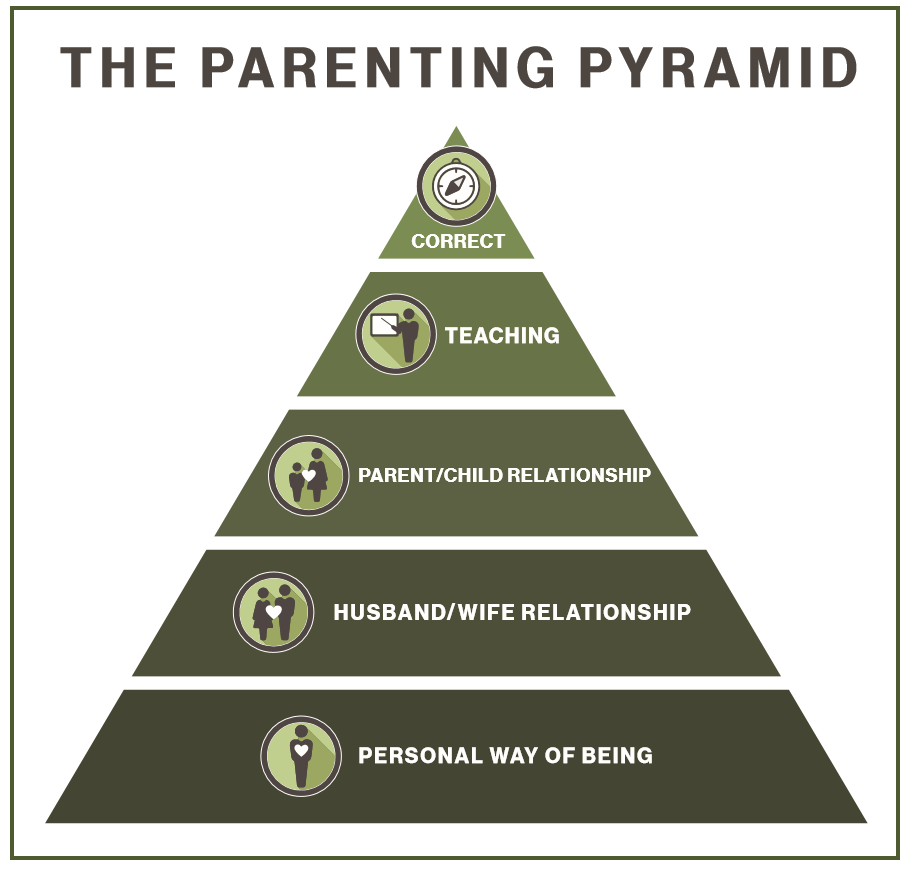
As you can see, the base of the pyramid is built on the Personal Way of Being. This is who we are at our core, or our fundamental way of being. When we are not our best selves we are certainly not able to be more than that to someone else. Self care, acceptance and personal development are at the center of what becomes the most important aspect of our interactions with others. Having a deep, solid foundation is essential to any structure and this is no different. We must work on ourselves before we can expect to have successful relationships. Everything comes back to this ground level.
Ideally, the next block in the pyramid is the marriage relationship. Research overwhelmingly demonstrates that the best situation for raising children is within a home with both a mother and a father who are married to each other. (Wilcox et al., 2012) When a person has a strong personal way of being, they are more likely to have a healthy marriage and the marriage relationship has a strong influence on the parent/child relationship which is the next level.
The parent/child level is all about the bond and respect the parent and child have for one another. We have all heard the adage that people don’t care how much you know until they know how much you care. In a simplistic way, this is true for children. When our relationships with our children are not strong, it is not possible for us to effectively teach or discipline them. Additionally, our relationships with our children will undoubtedly suffer when the levels below this on the pyramid are not solid. The authors of the theory suggest that when you are struggling in one area, you need only look to the level below to find the reason.
When the bond between parent and child is solid, teaching becomes a beautiful possibility. The respect that is shared proves the ideal environment for growth to happen. The root of the word discipline comes from the latin word discipulus, meaning student. We often misinterpret the meaning in our day, mistaking it for punishment. When we can effectively teach our children, the relationship is not only preserved but strengthened.
Most of our time should be spent on these first 4 blocks. Occasionally, there will be a need (hopefully not very often) that our children will need correction. It is the smallest block on the pyramid because it should require the least time. I also like that it is sharp on the top, reminding us that it needs to be to the point and not used as a bludgeon. If there seems to be an increase of time directed to this area, we only need to follow the formula and look to the block below until we unravel the problem.
I am not a believer in the idea that one theory as the solution to all parenting. However, this is a good place to start when we are seeking to strengthen our families.
 reallfe.family.blog